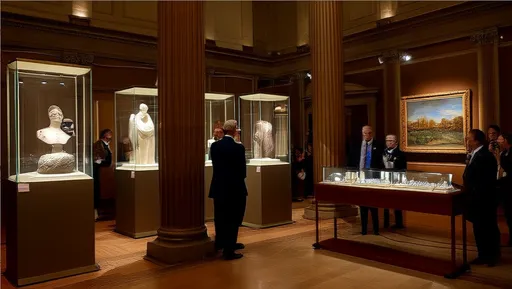
The art world is abuzz with the unveiling of a remarkable Southeast Asian private collection, bringing the profound and often enigmatic works of Mai Trung Thứ into a brilliant, focused light. This exhibition, a significant cultural event, does more than simply display paintings; it orchestrates a dialogue across time and space, presenting a compelling narrative of modern art's multifaceted evolution through the singular vision of a Vietnamese master. For decades, Mai Trung Thứ's oeuvre has been somewhat secluded within private circles, appreciated by connoisseurs but not widely accessible to the public. This presentation shatters that exclusivity, offering a comprehensive journey into an artistic universe where East and West coalesce with poetic grace and technical mastery.
Mai Trung Thứ, born in 1906 in northern Vietnam, was part of the first generation of graduates from the École des Beaux-Arts de l'Indochine, an institution founded by the French painter Victor Tardieu. This academy was instrumental in forging a new artistic identity for Vietnam, blending rigorous European academic training with traditional Vietnamese and broader East Asian aesthetic sensibilities. Thứ, along with contemporaries like Lê Phổ and Vũ Cao Đàm, embarked on a path that would lead him to Paris in 1937, where he would reside for the rest of his life. This geographical and cultural displacement is the crucible in which his unique style was forged. The collection on display masterfully traces this trajectory, from his early works imbued with a search for identity to the mature, instantly recognizable silk paintings that became his signature.
The heart of this exhibition lies in its revelation of Thứ's preferred medium: silk. He was a virtuoso of silk painting, a technique demanding immense patience and precision. Unlike the bold, often aggressive strokes of Western oil painting, Thứ's art is one of subtlety and delicacy. He applied ink and gouache to silk with a feather-light touch, creating images that seem to breathe, their colours glowing with an inner luminescence. The subjects are frequently intimate and tranquil—graceful women in áo dài, serene mother-and-child scenes, and contemplative figures in muted, dreamlike landscapes. These are not grand historical tableaux but moments of quiet introspection, capturing a world of poetic melancholy and refined elegance. The collection showcases his unparalleled ability to use the transparency of the silk to create layers of depth, making each piece a window into a hushed, emotional realm.
What makes this private collection so pivotal is its demonstration of Thứ's role as a cultural synthesizer. His work is a testament to the complex identity of the modern Vietnamese intellectual in the 20th century. The influence of his French academic training is evident in his understanding of form, perspective, and composition. The figures are rendered with a classical solidity, their poses natural and lifelike. Yet, the soul of his art is profoundly Asian. The lyrical line, the economy of detail, and the emphasis on capturing a mood or essence rather than a photographic reality are deeply rooted in traditions of Chinese and Vietnamese ink wash painting. This synthesis is not a mere pastiche but a genuine fusion, creating a visual language that is entirely his own—a modern art that speaks with an ancient, tranquil voice.
The theme of memory and diaspora permeates the entire collection. Living in self-imposed exile in France, Thứ's art became a vessel for nostalgia and a connection to a homeland he chose to leave yet never truly abandoned. His paintings are often seen as idealized memories of Vietnam, filtered through the soft focus of time and distance. The women he depicts are archetypes of Vietnamese grace and beauty, symbols of a culture he sought to preserve on silk. This exhibition powerfully contextualizes these works within the broader narrative of post-colonial identity and the artist's search for a personal and cultural anchor in a rapidly changing world. It shows that his art is not an escape from reality but a profound engagement with it, using beauty as a means to process loss and preserve heritage.
Furthermore, the exhibition compellingly argues for Mai Trung Thứ's place within the global narrative of modernism. Too often, the story of 20th-century art is told exclusively from a Western perspective, with movements like Cubism, Surrealism, and Abstract Expressionism dominating the discourse. This collection challenges that hegemony. It presents Thứ's work as a parallel, yet equally significant, modernism—one that sought modernity not through radical abstraction or shock tactics, but through a refined re-interpretation of tradition. His modernism is introspective, lyrical, and humanistic. By placing his silk paintings alongside the context of his time, the exhibition invites viewers to reconsider the very definition of "modern art," expanding it to include diverse pathways and cultural contexts.
The sheer quality and rarity of the pieces in this private holding are staggering. From early sketches that reveal his academic foundation to large-scale, exquisitely detailed silk masterpieces, the collection offers an unprecedented depth of insight. One can trace the evolution of his palette, which grew more sophisticated and nuanced over the years, incorporating muted earth tones and sudden, delicate flashes of colour. The curation wisely allows the works to speak for themselves, grouping them not strictly chronologically but thematically, creating dialogues between pieces from different periods that explore similar emotional or visual concerns. This approach highlights the consistency of his vision while also revealing its subtle shifts and developments.
In conclusion, the presentation of this Southeast Asian private collection dedicated to Mai Trung Thứ is far more than an art exhibition; it is a cultural revelation. It successfully pulls a major artist from the periphery into the center of art historical discourse, showcasing a modernism that is delicate, poetic, and deeply resonant. The collection does not simply display beautiful objects; it tells a story of cultural fusion, personal memory, and the enduring power of artistic tradition in the face of modernity. It reminds us that the landscape of 20th-century art is vast and varied, and that masters like Mai Trung Thứ, with their silent, luminous paintings on silk, offer a different, but no less powerful, vision of what it means to be modern. This exhibition is an essential pilgrimage for anyone seeking to understand the rich, complex, and truly global tapestry of modern art.
By /Sep 25, 2025
By /Sep 25, 2025

By /Sep 25, 2025
By /Sep 25, 2025
By /Sep 25, 2025
By /Sep 25, 2025
By /Sep 25, 2025
By /Sep 25, 2025
By /Sep 25, 2025
By /Sep 25, 2025
By /Sep 25, 2025
By /Sep 25, 2025
By /Sep 25, 2025
By /Sep 25, 2025

By /Sep 25, 2025
By /Sep 25, 2025
By /Sep 25, 2025
By /Sep 25, 2025
By /Sep 25, 2025
By /Sep 25, 2025
